
Choosing moving supplies and boxes in Bloomington starts with the carry, not the catalog.
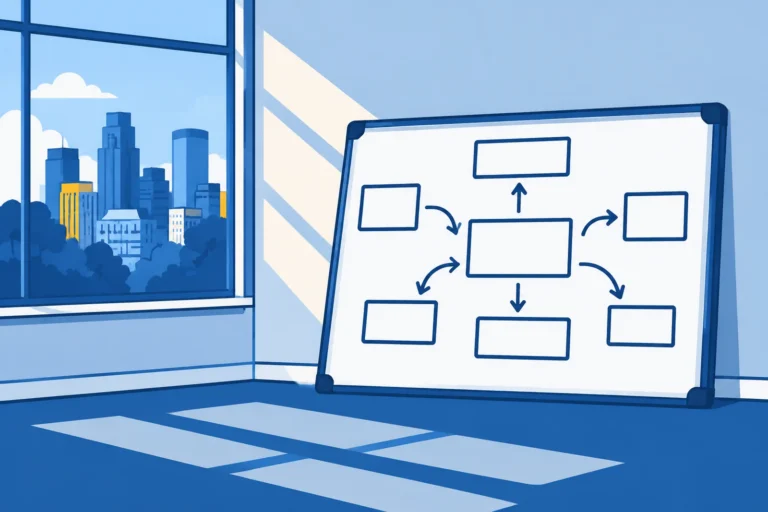
Sketch the path from where the truck stops to the room the box lands in, marking the doorways a loaded carton must pass through, the stair turn, and the landing at the top. Let that one line decide what you buy.
Ask yourself whether a medium carton carried two at a time would beat a wardrobe box dragged alone on your route, and let the answer come from your own hallway.
Then use the sketch to make supply decisions rather than to redraw the route. Decide what goes in each carton size, label contents and destinations as you pack, and keep tape, markers and padding within reach so you are not hunting for them mid room.
The arrival path drawn first
That line is your real supply list.
Ask whether a long carry with a turn would suit smaller cartons and a hand truck better than a few oversized boxes. On a short flat carry, weigh whether fewer, larger boxes would let you make fewer trips. Let the sketch answer before the shelf does. If the door sits at the top of a stair run, put the heavy items in small cartons and the light bulky items in large ones.
Nobody wants a book box on the third landing.
Which container sizes survive a single road carry
As a household suggestion rather than a rule, start with a small carton for books and dense items, a medium for kitchen and general goods, and a large for bedding and light bulky items. Adjust once you see how the carry feels on your own route. Add a specialty box only when the item demands it. USPS advises strong packaging with enough room to add cushioning for fragile items and to prevent shifting for mail shipments.
Pack tight, leave a little air for padding, and fill gaps so nothing slides.
| Container | What it carries | Carry note |
|---|---|---|
| Small carton | Books, tools, canned goods | Check if carrying a pair suits your stairs |
| Medium carton | Kitchen, pantry, general goods | Common choice for most rooms |
| Large carton | Bedding, pillows, light bulky items | Keep under a weight you can lift alone |
| Wardrobe box | Hanging clothes | Needs a helper and a clear door |
| Picture box | Framed art and mirrors | Check the maker’s packing instructions |
Match packaging to the item and the maker’s instructions before you choose protection. Read the maker’s packing guidance for framed art, electronics and other fragile pieces, and ask the box supplier which carton suits the item. Record contents and destination on each carton as you pack, and sort kept cartons by size so the next room is easier to pack.
Reuse sources reachable without a second trip
Ask around before you buy.
Ask neighbors who just unpacked whether they have cartons to pass on, ask a workplace mailroom whether it sets aside reusable boxes, and post in a local buy nothing group to ask what is available. Ask for reusable supplies rather than assuming a store or a neighbor has a stack waiting. Confirm condition and availability before arranging a pickup. The EPA ranks source reduction and reuse above recycling in its waste hierarchy, so a carton that makes a second move is the better outcome than one that goes straight to the curb.
Check condition before you accept one: no soft spots, no damp corners, no crushed panels, and no torn seams.
When reusing a box, cover or black out all old logos, barcodes, shipping labels and addresses, per USPS guidance. A carton with a stranger’s address still on it is a confusion waiting to happen on the truck. If the boxes are coming from a business, ask whether they held food or chemicals, and let the answer decide whether that carton joins the packing pile.
For the physical loading side of the day, see moving labor.
Flattening and collection on the return leg
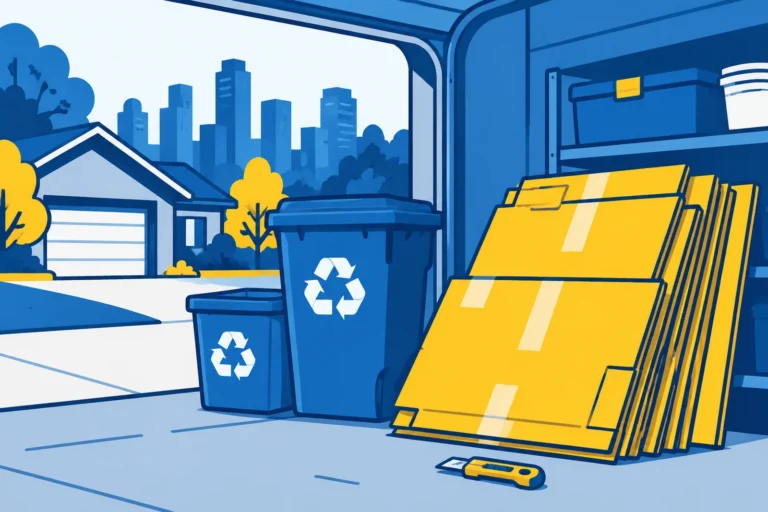
Unpacking leaves a wall of cardboard, so plan what you will keep, offer for reuse or recycle. Flatten as you go, cut the tape, fold the flaps, and stack the flat cartons against a wall until the pile is worth a trip. Ask your waste hauler what the carton rules are for your exact address before you set anything at the curb.
The EPA notes that local programs may have rules different from its general answers.
Check the program serving your actual address. For a broader look at what your community program takes, see the EPA guidance on common recyclables. Bundle flat cartons to a size one person can carry and tie them so they do not blow apart on a windy morning. Ask the hauler about any weather rule for setting cartons out, and keep the pile where runoff will not soak it.
Decide reuse versus recycling before you fold anything. Flattening a sound carton for storage or to offer it for reuse is fine; flattening a damaged one for recycling is a separate decision. A sound carton saved now is one less purchase next time.
Ask the building manager where flattened cardboard belongs, since a designated spot may not match the street cart.
Storing cartons for a later reuse
Store flattened cartons dry and flat, tied in bundles you can lift, and label each bundle by size. Keep the bundles off a damp floor and out of standing water, and check them before the next move. Keep the specialty cartons too, the picture boxes and the wardrobe boxes, since a sound one saves a purchase later. If a carton shows soft spots, damp corners, crushed panels or torn seams, set it aside rather than storing it.
If you are packing a home office or a garage, see packing services for how the room by room work is usually handled.
The arrival choice that outranks the box choice
- Watch the forecast. Check the snow emergency information before you set a loading plan on a winter date.
- Move the car. When the City of Bloomington declares a snow emergency, a parking ban is in effect and all vehicles must be moved from City streets until plowed full width.
- Know the window. Snow related parking bans remain in effect for 48 hours, or until the street you park on has been plowed full width, whichever comes first.
- Expect a tow. Cars parked during a ban may be towed, so keep the truck off the street until the plow has passed.
Check the snow emergency information before you set a loading plan on a winter date. Build a weather buffer into the schedule and keep the truck off the street until the plow has passed. For the full picture of a Bloomington move, see Bloomington moving, and for a quote on the day itself, request a quote.